

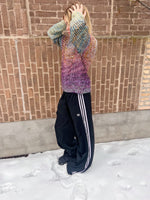
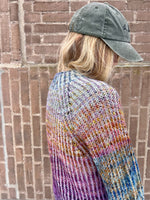
DUNA SPECIAL EDITION - English
Kategori: ENGLISH - PATTERNS
English version
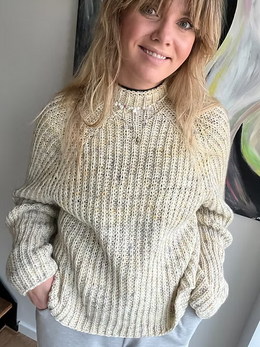
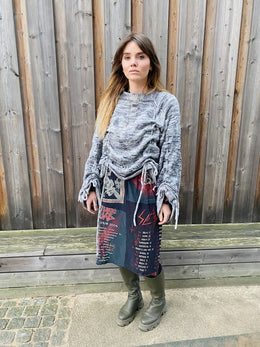
Style DUNASWEATER is a knitwear pattern instructions. The pattern comes in a PDF file, and can be downloaded and printed from the computer.
Size chart
Size (cm) XS (S) M (L) XL (XXL) 3XL (4XL) cm
1.Bust circumference
98 (105) 119 (123,5) 127 (134) 138 (145)
2.Length measured mid back excl. neck edge
47 (48,5) 52,5 (56) 56,5 (58,5) 58,5 (58,5)
The measurements are based on the sweater after wash. Duna sweater is designed to have approx 25 - 35 cm of positive ease, especially in the smaller sizes, but gradually less positive ease in the larger sizes, meaning how much larger in circumference the sweater is designed to be than your body’s bust measurement.
Skills : Brioche stitch in round with increase and decrease.
Material
Fingering Organic, hand dyed organic merino wool from Thelma Steimann. Approximately 80m per 20g. Smooth, soft and non-scratchy yarn.
Fingering Organic: ca 490gr (550gr) 620gr (640gr) 670gr (700 gr) 730gr (750gr)
Circular needle 5,5 mm in 40 and 100/80 cm
Tapestry needle for weaving in the ends
Stitch markers
Row counter
Keeping cord for resting stitches
Tension gauge sample
Make sure to check your own tension before starting to knit.
Cast on 11 stitches with double strand of Fingering Organic and knit 30 rows with fisherman’s rib, the first row is rep ; k 1 st, p 1 st. In the following rows you just *rep ; Knit 1 below, p* on needles 5,5 mm for a 10 x 10 cm sample. Wash and block the sample, the sample should increase after washing. Take note that the sweater is knitted in round and the sample is worked back and forth.
If tension measures too tight, change to a thicker needle.
If tension measures too wide, change to a thinner needle.
Good to know
The sweater is worked top down in round for the whole project. The yoke is worked with a raglan increase and separated by the armpits into sleeves and body. The sleeves are knitted with decrease.
The sweater is knitted with half fisherman’s rib, or better known as brioche stitch. It´s worked by moving the knitted stitch over unknitted with yarn over in every other row.
When you are working the increase or the decrease, you will always be adding or removing 2 sts at the same time.
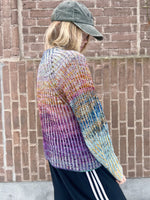
You’ll find pre-selected yarn combinations in KITs on the homepage to help you choose colours that fade beautifully into one another. The pattern provides approximate yarn usage as a guideline. The mini hanks don’t all have to be in different colours, and the sweater can also be knitted in a single colour throughout (though in that case, Duna Original might be a better choice for you). This design is also perfect for using up leftover yarns.
The sweater is knitted with double strand of Fingering Organic throughout the project, so you’ll always be knitting with two strands held together.
Ideas for working the colours
There are many ways to combine the colours , here are a few options:
1. Ombre / fade from light to dark
You can create an ombre look by going from light to dark (or the other way around). Simply choose an order of colours that gradually shifts and follow that as you knit.
2. Horizontal stripes
If you want horizontal stripes:
Work with 2 colours held together at a time. When you’re ready to change, switch to the next 2 colours. If you want the same number of rows in each stripe, just count your rows.
Keep in mind that as the sweater grows, each row becomes physically longer, so don’t make the first stripes too tall, otherwise the top of the sweater may feel “heavier” than the rest and the stripes become shorter.
3. Vertical stripes (brioche effect)
For vertical stripes, you’ll be working with 4 strands in total, 2 strands for each colour combination:
You still knit with 2 strands at a time, But you have another set of 2 strands that you work with every other row.
In this case, you need to decide:
Which colour pair is for the brioche stitch (the one that pops), and
Which colour pair is for the purled background.
If you look at the pattern:
The colour you use for row 2 will be the purled colour.
The colour you use for row 3 will be the one that the brioche stitch appears in.
4. Faded colour transitions
You can also create a fade just by blending colours as you go:
Knit with 2 strands held together. When you are about halfway through a hank, cut one of the strands and replace it with a new colour. This way, you are always “bleeding” one previous colour into the next, creating a soft transition instead of hard blocks.
Forsendelse & Returnering
Vi sender fra København, Danmark, med omhu og hensigt – ligesom vores produkter.
Fragt inden for Danmark er 50 DKK og international fragt er 132 DKK.
Vi tilbyder gratis fragt på ordrer over:
• 500 DKK i Danmark
• 800 DKK internationalt
Returneringer og tilbagebetalinger
Har du skiftet mening? Intet problem. De fleste varer kan returneres inden for 14 dage efter købet, så længe de er i original stand - ubrugte, uvaskede, med tags intakte.
Bemærk venligst: Håndstrikkede styles og strikmønstre kan ikke refunderes.
Du modtager en refusion (ekskl. forsendelse), når vi har modtaget din retur og bekræftet, at alt er i god stand. Returneringsomkostninger er dit ansvar.